OCD · Family and peer support
What to say when someone with OCD asks for reassurance
Practice words for repeated checking, scary thoughts and everyday questions. Make a response plan together for the next hard moment.
Start by listening to the person
“Can you promise I didn’t upset her?” could be a request for your opinion, an attempt to repair an actual misunderstanding, or part of an OCD loop. The words alone won’t tell you which. Listen for what happened and what the person needs. If you genuinely owe someone information or an apology, give it.
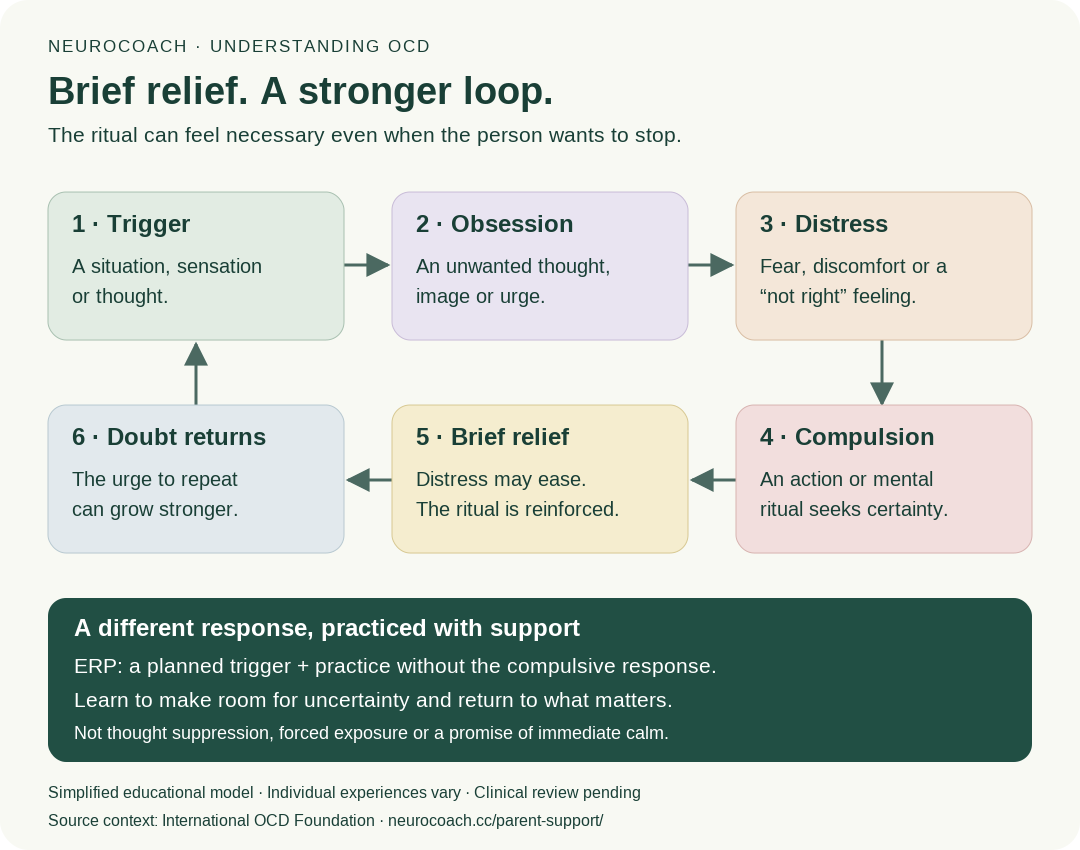
In OCD, an unwanted thought, image, urge or feeling can be followed by a strong need to get certainty. Repeated checking, confessing, researching or asking for a promise can bring brief relief. Then the doubt can return. You can offer warmth and companionship while stepping out of a ritual you’ve both recognized.
Agree on a response when things are calm
Ask permission to talk. Try, “I’ve noticed that rereading your messages together helps for a minute, then you feel awful again. Does that fit your experience? What would you like me to do next time?” Use the person’s preferred words. Some people like calling the pattern OCD. Others find that feels dismissive.
- Pick one familiar situation. Agree on a phrase that feels kind and an offer you can keep, such as sitting nearby or going back to lunch together.
- Ask what actually helps them communicate. A written answer about a changed schedule, a quiet room or more time to process may be an access need. Keep those supports available.
- If relatives have been taking part in rituals, change one response at a time. Use the person’s OCD clinician to plan a gradual change, especially with children or when distress is severe.
Words you can borrow in the moment
“Read my text again. Are you absolutely sure I didn’t offend my friend?” You have already read it together and agreed how to handle repeats.
“I hear how much this friendship matters to you. I’ll stick with our plan and leave the text alone. Want some company while you get on with your evening?”
You acknowledge what the person cares about, avoid another round of reviewing, and leave the next activity up to them.
“Go back and check the door for me. Just this once.” You both recognize this as the usual request after ordinary locking.
“Leaving feels hard today. We agreed I’d walk with you without going back to check. Would you like to walk quietly or talk?”
You follow an agreement made together. A genuinely new concern, such as someone reporting the door is open, deserves an ordinary practical response.
“I had a horrible thought. Tell me what kind of person would think that.”
“That sounds upsetting. I’m glad you told me. I can sit with you. Would you like help bringing this up with your clinician?”
You make it easier to disclose distress without putting the thought on trial or asking for a detailed confession. If the person describes wanting or planning to act, address safety directly.
“What time will you pick me up?” The pickup changed yesterday, or the person didn’t hear or remember it.
“At four, by the side door. Shall I text it so you have it to hand?”
A clear answer supports communication and memory. A repeated question by itself cannot tell you that someone is seeking reassurance as a compulsion.
“If you cared, you’d promise me.”
“I do care. I can hear that this is painful. I’ll stay for a few minutes like we planned. Would you like quiet or company?”
Keep your voice low, your offer specific and your limit steady. You can revisit the agreement later if it felt unkind or unrealistic.
If you get it wrong, repair the conversation
If you snapped or called a reasonable question OCD, try, “I spoke for you. What were you trying to find out?” If you got drawn into checking, try, “I got caught up in rereading it, too. Can we return to the plan we made?” A difficult moment is information for the next conversation.
Shaming, teasing, surprise exposure exercises and abrupt withdrawal of all help can damage trust. Keep affection, ordinary safety practices, accessibility supports and invitations to everyday life in place. A therapist trained in exposure and response prevention (ERP) can help the person choose manageable practice steps and invite family involvement with their agreement.
Know when to get more help
If distress, rituals or avoidance are taking over meals, sleep, school or work, ask about an OCD assessment and a clinician trained in ERP. You might ask, “How would you help us tell the difference between family participation in a ritual and support this person needs for autism or ADHD?”
Unwanted thoughts about harm can occur in OCD. Take a new disclosure seriously and listen without assuming what it means. If you’re unsure about immediate safety, ask plainly whether the person wants to act or has a plan to hurt themselves or someone else. If there is immediate danger or the person cannot stay safe, contact emergency services now. If there is no immediate danger but the experience is new, confusing or worsening, seek prompt professional assessment.
A small plan to print or write together
- The situation we recognize is ______. New information or a real safety concern might look like ______.
- The words I want to hear are ______. A phrase I find upsetting is ______.
- When the question comes back, you can offer ______. I can ask for a pause by ______.
- We’ll check in again on ______. If we need professional support, we’ll contact ______.
Sources and contacts
- International OCD Foundation · How families can help
- International OCD Foundation · Exposure and response prevention
- NICE · OCD recommendations for assessment, risk and family involvement
- International OCD Foundation · OCD and autism resource center
- National Institute of Mental Health · Questions about suicide and immediate safety (PDF)