OCD can attach to things a person cares deeply about. An obsession is an intrusive, unwanted thought, image or urge. A compulsion is an action or mental ritual used to reduce distress, seek certainty, or prevent a feared outcome.
The cycle can feel controlling without being a deliberate choice. A short burst of relief can make the ritual feel more necessary next time. Below, explore the cycle and compare two family responses to the same situation.
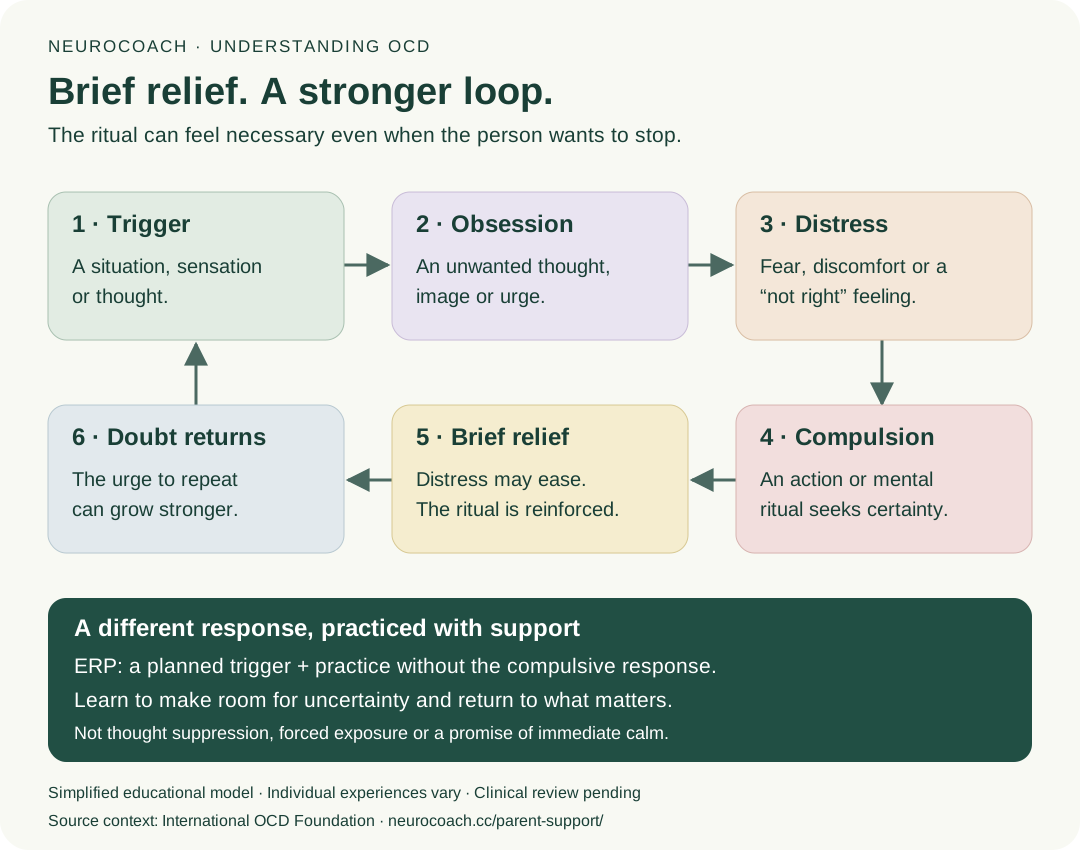
Read the graphic as text
- A trigger brings up an unwanted thought, image or urge.
- The obsession feels urgent; distress or a “not right” feeling grows.
- A compulsion—an action or mental ritual—aims to remove distress or prevent something feared.
- Brief relief can reinforce the ritual. Doubt returns and the cycle repeats.
ERP offers planned practice, with a qualified clinician, approaching a trigger without the compulsive response. The goal is more freedom in the presence of uncertainty, not eliminating thoughts or forcing immediate calm. Keep necessary sensory and communication supports.
Download the graphic · Source context: IOCDF on ERP · Original NeuroCoach illustration.
Browse all sections in this guide
Helping with a compulsion: now versus over time
When someone you love is distressed, helping them check, review or feel certain can seem kind. This is called family accommodation when it becomes part of the OCD ritual. The immediate relief and the longer-term learning can point in different directions.
Choose an example to compare the two paths. The alternative assumes a gradual plan agreed with the person and their OCD clinician. It is not a suggestion to suddenly withdraw help or make someone face a fear against their wishes.
Showing: Repeated checking
The same starting pointThe door has been locked in the usual way. An adult asks their parent to check it again, take a photo, then return for one more check.
Helping perform the compulsion
Also called family accommodation
In the moment
The parent checks again and sends a photo: “See? It is definitely locked.”
Both may feel relief. But the extra check can become the condition for feeling able to leave.
When doubt returns
The urge to ask again can grow. Relief may teach both people to repeat the ritual whenever distress appears.
With repetition over time
The family can become more involved in checking, reassurance or avoidance. Rituals may take more time and make everyday activities harder.
What can get reinforced: “I need the ritual, or someone else’s certainty, to cope.”
Supporting practice without the ritual
A step agreed with the person and their OCD clinician
In the moment
Under the agreed plan, the parent skips the extra check: “I know the doubt feels urgent. I can walk with you while you practice leaving.”
The person practices leaving without another check. Anxiety may rise or remain present; the parent stays supportive.
When doubt returns
The person gets another chance to follow the plan without seeking certainty. Distress can fluctuate; immediate calm is not the measure of success.
With repetition over time
Supported ERP practice can reduce OCD’s interference and reliance on rituals, making more room for everyday life. Progress varies and setbacks can happen.
What the person can learn: “I can take a meaningful next step even while I feel uncertain.”
The same starting pointAfter an ordinary conversation, a person repeatedly asks, “Are you absolutely sure I did not offend anyone?” A clinician has identified this repeated certainty-seeking as part of their OCD.
Helping perform the compulsion
Also called family accommodation
In the moment
The parent explains again why nobody is upset, reads the messages again and promises there is nothing to worry about.
The answer may settle the worry briefly. Another “But what if?” can restart the conversation.
When doubt returns
The urge to ask again can grow. Relief may teach both people to repeat the ritual whenever distress appears.
With repetition over time
The family can become more involved in checking, reassurance or avoidance. Rituals may take more time and make everyday activities harder.
What can get reinforced: “I need the ritual, or someone else’s certainty, to cope.”
Supporting practice without the ritual
A step agreed with the person and their OCD clinician
In the moment
Following the agreed plan: “I hear how worried you are. I care about you. Let’s use the plan for leaving this question unanswered.”
The person practices returning to their evening without another verdict. This does not mean ignoring a real misunderstanding or withholding ordinary affection.
When doubt returns
The person gets another chance to follow the plan without seeking certainty. Distress can fluctuate; immediate calm is not the measure of success.
With repetition over time
Supported ERP practice can reduce OCD’s interference and reliance on rituals, making more room for everyday life. Progress varies and setbacks can happen.
What the person can learn: “I can take a meaningful next step even while I feel uncertain.”
The same starting pointA person keeps replaying a memory to prove they are a good person and asks their parent to reconstruct every detail. The review has been identified as an OCD ritual.
Helping perform the compulsion
Also called family accommodation
In the moment
The parent becomes a detective, repeatedly comparing details and helping produce one more proof that the person did nothing wrong.
A convincing explanation may feel relieving until a new detail seems uncertain. The ritual can continue silently as mental reviewing.
When doubt returns
The urge to ask again can grow. Relief may teach both people to repeat the ritual whenever distress appears.
With repetition over time
The family can become more involved in checking, reassurance or avoidance. Rituals may take more time and make everyday activities harder.
What can get reinforced: “I need the ritual, or someone else’s certainty, to cope.”
Supporting practice without the ritual
A step agreed with the person and their OCD clinician
In the moment
Using the agreed plan: “I can see this is painful. I won’t go through the evidence again. Would you like some company while you return to what you were doing?”
The person practices allowing uncertainty without another review, including mental reviewing. This is different from suppressing a thought or avoiding genuine accountability.
When doubt returns
The person gets another chance to follow the plan without seeking certainty. Distress can fluctuate; immediate calm is not the measure of success.
With repetition over time
Supported ERP practice can reduce OCD’s interference and reliance on rituals, making more room for everyday life. Progress varies and setbacks can happen.
What the person can learn: “I can take a meaningful next step even while I feel uncertain.”
Original hypothetical examples, not a forecast or a fixed recovery timeline. Family accommodation is often a caring response to distress; it does not mean a parent caused OCD. One difficult day does not determine the outcome.
Source context: Yale: family accommodation and the OCD cycle · International OCD Foundation: family guidelines · International OCD Foundation: ERP treatment and longer-term outcomes
What progress can look like in daily life
The longer-term aim is more choice: getting out the door, enjoying a conversation or returning to an activity without first resolving every doubt. Look for less time lost to rituals and more participation in what matters to the person, rather than requiring zero intrusive thoughts or zero anxiety.
A parent stepping back is only one part of the picture. If the person completes the ritual alone, replaces it with mental reviewing, or avoids the situation entirely, the cycle may continue. Discuss those patterns with the clinician without policing the person's thoughts.
Source context: International OCD Foundation: ERP treatment and longer-term outcomes · NHS: OCD symptoms and mental rituals
Agree on the change before the difficult moment
Choose one manageable accommodation with the person and clinician. Agree what the family will say and do, what support remains available, and how to adjust the plan if it is too hard. An adult's consent and choices matter. If they do not want treatment, family members can seek their own professional guidance on supportive boundaries.
Keep ordinary safety checks, appropriate medical care, affection, and needed sensory or communication supports. A genuine new concern deserves attention. Distress is not automatically an OCD exercise: if there is danger, threats or an acute change in mental health, prioritize safety and professional help instead of pushing through the practice.
Source context: International OCD Foundation: family guidelines · National Autistic Society: OCD and autism · International OCD Foundation: ERP treatment and longer-term outcomes
Common themes are examples, not separate diagnoses
Themes can include contamination, fear of causing harm, unwanted sexual thoughts, religious or moral fears, relationship doubt, symmetry, and a sense that something is not right. Content can change while the underlying cycle stays similar.
An unwanted intrusive thought is not the same as a desire, intention or action. Still, do not use a list to decide that every statement about harm is harmless: expressed intent, a plan or a safety change needs assessment. A clinician considers the whole situation.
Source context: International OCD Foundation: understanding OCD
Compulsions can happen quietly
Alongside washing and checking, compulsions can involve reviewing memories, mentally repeating words, counting, neutralizing a thought with another thought, confessing, or repeatedly asking for reassurance. Avoidance may also shape daily life.
The question is not simply whether an action repeats. Ask what the person fears will happen without it, how distressing it is, and how much time it consumes. A professional can assess this without requiring family members to interrogate or police every thought.
Source context: NHS: OCD symptoms and mental rituals
Why trying to take total control can keep the loop going
Trying to prove complete safety or remove every unwanted thought can turn into another ritual. A family may get pulled into repeated checking or certainty-seeking because everyone wants relief. That does not mean the parent caused OCD.
In ERP, a person works with a trained clinician on planned, manageable practice facing triggers while reducing compulsive responses. The aim is more freedom to live with uncertainty, not a guarantee that anxiety disappears immediately. Exposures are not punishment and should not be improvised or forced by relatives.
Source context: International OCD Foundation: family guidelines · International OCD Foundation: exposure and response prevention
Support the person without becoming the certainty service
If there is an agreed treatment plan, ask the person and clinician which family responses support it. Make changes gradually as planned. Do not abruptly refuse all questions, confuse necessary information with reassurance rituals, or remove sensory and communication supports.
An original phrase to discuss with the treating clinician: “I can see how strong the urge feels. I care about you. Would you like me to sit with you while you use the plan we agreed?” The phrase is support, not proof that nothing bad can happen.
Autistic interests and stimming need a different lens
Do not assume a favorite subject, movement or routine is OCD. Ask whether it brings enjoyment, accessibility or regulation, versus an unwanted obligation to prevent something feared. The distinction can be complex, especially with limited spoken communication. Seek an autism-informed OCD assessment when distress or impairment is present.
Source context: National Autistic Society: OCD and autism
Related guides
Explore the caregiver center →About this guide
General education and original examples, not medical advice, a diagnosis or an individualized treatment plan. Discuss treatment decisions with a qualified clinician. NeuroCoach coaching provides nonclinical navigation and planning support.
Review status: Independent clinical review pending.
Published October 24, 2026 · Last content update October 24, 2026 · Sources checked October 24, 2026
Sources & editorial approach
These sources provide the background guidance identified above. The examples and planner are NeuroCoach educational material; they have not been tested as a clinical intervention. Source inclusion does not imply endorsement of NeuroCoach coaching.
- Yale: family accommodation and the OCD cycle
- International OCD Foundation: family guidelines
- International OCD Foundation: ERP treatment and longer-term outcomes
- NHS: OCD symptoms and mental rituals
- National Autistic Society: OCD and autism
- International OCD Foundation: understanding OCD
- International OCD Foundation: exposure and response prevention