OCD is often reduced to being tidy or checking things. That misses the distress and the amount of life the condition can take up. It can also make invisible compulsions harder to recognize.
This informational overview explains a common pattern. A clinician considers the whole picture; a checklist, repeated behavior or intrusive thought alone cannot diagnose OCD.
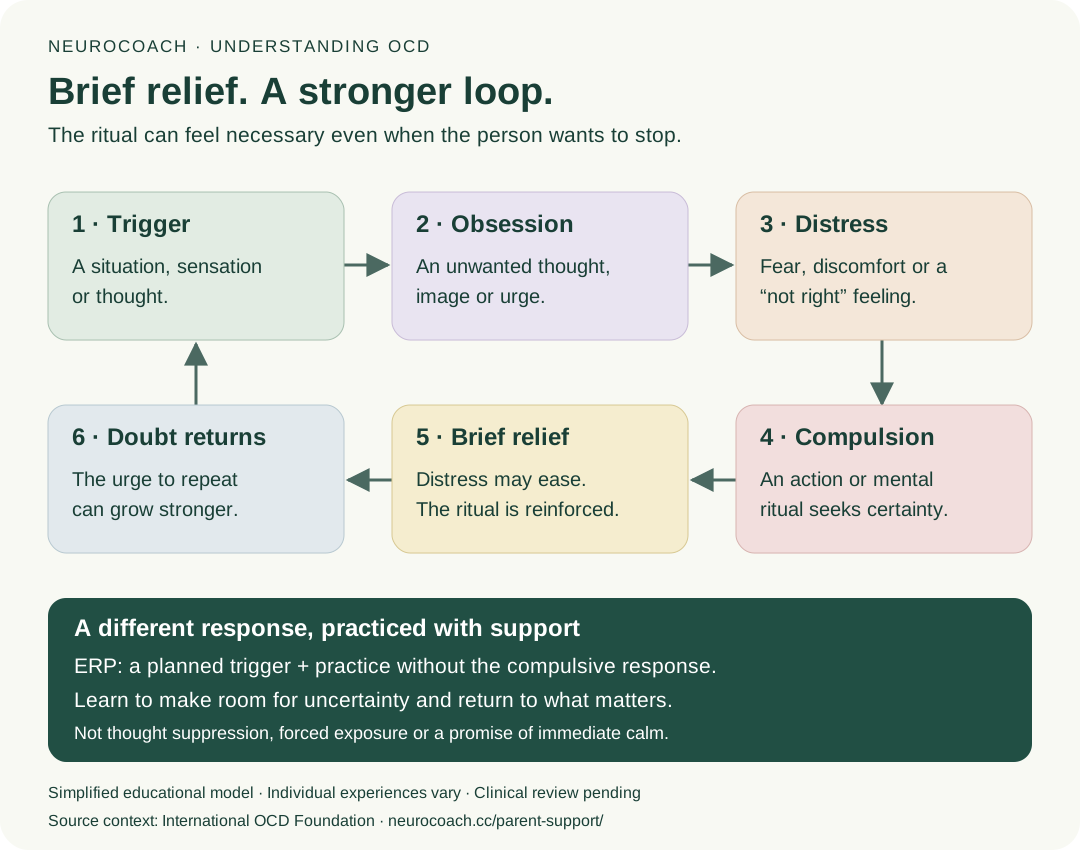
Read the graphic as text
- A trigger brings up an unwanted thought, image or urge.
- The obsession feels urgent; distress or a “not right” feeling grows.
- A compulsion—an action or mental ritual—aims to remove distress or prevent something feared.
- Brief relief can reinforce the ritual. Doubt returns and the cycle repeats.
ERP offers planned practice, with a qualified clinician, approaching a trigger without the compulsive response. The goal is more freedom in the presence of uncertainty, not eliminating thoughts or forcing immediate calm. Keep necessary sensory and communication supports.
Download the graphic · Source context: IOCDF on ERP · Original NeuroCoach illustration.
Browse all sections in this guide
What is an obsession?
Obsessions are recurring, unwanted thoughts, images or urges that intrude and cause distress. Themes can involve harm, contamination, responsibility, relationships or a sense that something is not right. The experience can include doubt, disgust or incompleteness as well as fear.
An intrusive thought is not, by itself, evidence of a person's wishes or intentions. Clinicians assess the context rather than judging someone by a thought's topic. Actual intent, behavior and safety concerns still need appropriate assessment.
Source context: International OCD Foundation: understanding obsessions and compulsions · NIMH: OCD signs, symptoms and treatment
What is a compulsion?
Compulsions are repeated actions or mental acts a person feels driven to perform, often to reduce distress, prevent a feared outcome or reach a ‘just right’ feeling. Examples include repeated washing or checking, silently counting, reviewing memories and repeatedly asking for reassurance.
The purpose and impact matter. An ordinary check, a valued religious practice or a preferred routine is not automatically a compulsion. OCD symptoms are time-consuming, cause significant distress or interfere with daily life.
Source context: International OCD Foundation: understanding obsessions and compulsions · NIMH: OCD signs, symptoms and treatment
Why the loop can keep returning
A common pattern is: an intrusive doubt brings distress; a ritual offers temporary relief; doubt returns and the urge to repeat the ritual grows. That short-term relief can reinforce reliance on the compulsion. It is a learning pattern, not a moral failure or a complete explanation of what causes OCD.
Imagine someone repeatedly rereading an ordinary message to feel certain it could not upset anyone. Each review settles the worry briefly, but then a new ‘what if’ appears. The treatment question concerns the repeated search for certainty, not finding an infallible message.
Source context: International OCD Foundation: exposure and response prevention · International OCD Foundation: digital reassurance seeking
The ritual may be happening inside
Mental compulsions can include reviewing an event, arguing with a thought, checking feelings or silently replacing a disturbing thought. A person can look still while working very hard to reach certainty. Trying to solve an unanswerable doubt again and again can keep them occupied even without visible rituals.
Online searching can serve the same function. Repeatedly asking a search engine, forum or AI for a definitive answer may become reassurance seeking. Looking up information is not automatically a compulsion; its function, repetition and impact are what matter.
Source context: International OCD Foundation: mental rituals and disengaging from rumination · International OCD Foundation: digital reassurance seeking
Responding to an urge without fighting every thought
In treatment, ‘counteracting’ an urge generally means practicing a different response to it, not forcing the thought out or proving its opposite. ERP helps someone approach an agreed trigger while practicing without the compulsion. The clinician and person decide what that looks like and how to support it.
A general way to understand this learning is: notice the pull toward a ritual, recognize the agreed practice, and return attention to a chosen activity while allowing uncertainty to be present. This is an explanation, not a timed exercise or a substitute for an individualized plan.
Source context: Society of Clinical Psychology: ERP for OCD · International OCD Foundation: inhibitory learning in ERP
Watch for a replacement ritual
Positive statements, breathing, distraction or a coping phrase can become another ritual if they must be repeated until the person feels safe or gets the ‘right’ feeling. Their purpose matters. A coping tool is not a requirement to erase discomfort before life can continue.
Discuss these patterns without blame. Difficult days and recurring urges are information to bring to treatment, not a test of character. Support should make it easier to seek help, not add another standard the person must meet perfectly.
Source context: IOCDF-hosted clinician resource: common OCD treatment myths (PDF) · International OCD Foundation: mental rituals and disengaging from rumination
When to ask for help
If thoughts, rituals or avoidance disrupt sleep, school, relationships or everyday tasks, ask a qualified clinician about an OCD assessment. You do not need to wait until symptoms fill the entire day. Bring a few examples of the pattern and its impact rather than an exhaustive diary.
For autistic people, the assessment should consider sensory needs, routines and communication as well as possible OCD. Tics can also coexist with OCD. Similar-looking repetitions can have different functions, so a supporter should not decide the diagnosis from appearance alone.
Source context: NIMH: OCD signs, symptoms and treatment · International OCD Foundation: treating OCD in autistic people
Related guides
Explore the caregiver center →About this guide
General education and original examples, not medical advice, a diagnosis or an individualized treatment plan. Discuss treatment decisions with a qualified clinician. NeuroCoach coaching provides nonclinical navigation and planning support.
Review status: Independent clinical review pending.
Published October 23, 2026 · Last content update October 23, 2026 · Sources checked October 23, 2026
Sources & editorial approach
These sources provide the background guidance identified above. The examples and planner are NeuroCoach educational material; they have not been tested as a clinical intervention. Source inclusion does not imply endorsement of NeuroCoach coaching.
- International OCD Foundation: understanding obsessions and compulsions
- NIMH: OCD signs, symptoms and treatment
- International OCD Foundation: exposure and response prevention
- International OCD Foundation: digital reassurance seeking
- International OCD Foundation: mental rituals and disengaging from rumination
- Society of Clinical Psychology: ERP for OCD
- International OCD Foundation: inhibitory learning in ERP
- IOCDF-hosted clinician resource: common OCD treatment myths (PDF)
- International OCD Foundation: treating OCD in autistic people